Golden Age of Super Intelligence (Part II)
30 September 2026

What came out of the White House’s much hyped Golden Age Summit on AI yesterday?
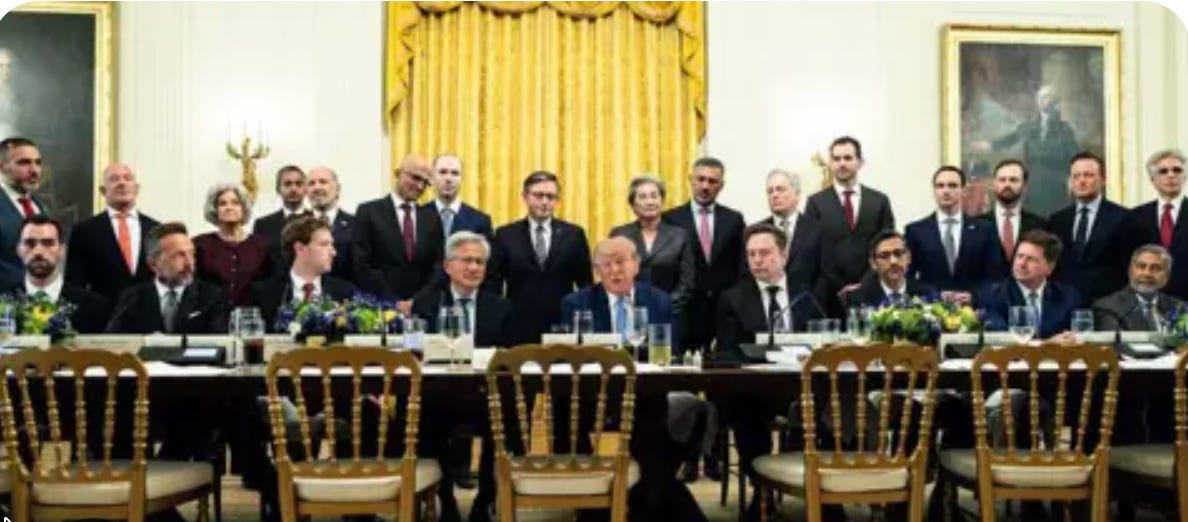
Billionaires Luncheon: The president dined with billionaire tech executives at a ‘Super Intelligence Luncheon.” Among those in attendance, Anthropic CEO Dario Amodei, Nvidia’s Jensen Huang, Tesla’s Elon Musk and many others (see the seating chart below). For a gathering this large, it was notable there was just one female tech executive at the table, AMD CEO Lisa Su.
Re-branding: President Trump signed an EO decreeing ‘AI’ should now be known as ‘Super Intelligence’
Morally Binding Regs: President Trump also announced that the tech leaders signed a “constitution” to police themselves. When asked about how they would be enforced, Trump noted that the principles are “morally binding.”

In short, the entire summit was a lost opportunity which amounted to not only bad politics, but terrible policy.
On the politics, it was a bad day for the GOP. Just 35 days before the midterm, as people are screaming from the rooftops that they can’t afford gas, diesel, rent, groceries, and the like, the president doesn’t focus on bringing down costs but rather hosts a lavish golden age luncheon with some of the wealthiest people on the planet. Not to mention, those at the table are the same people who developed, own and run some of the largest and most profitable AI companies in the world; a technology that Americans are increasingly wary of.
A recent CNN poll found that 3/4 of Americans are fearful about the impacted of unregulated AI. At the same time, a Reuters/Ipsos poll found than almost the same percentage of Americans believe not enough has been done to stop the technology from causing serious harm to society.
The questionable politics pale in comparison to the lack of seriousness when it comes to policy.
Dissenting/alternative voices excluded: Instead of hosting a wide array of people who study and have interest in this issue from all walks of life, some of whom may push back on the administration’s position on this issue, the ‘summit’ was restricted to Silicon Valley types who largely agree with the president’s hands off approach
There was not, for instance, any reflection of the views of people like Pope Leo XIV who pushed back on Trump’s suggestion that the ‘dooms-day’ narrative is a hoax and who, in his May Encyclical Magnifica Humanitas, warned that unregulated tech advancements present a risk to humanity.
Likewise, there was no one in attendance like Trump’s close confidant Steve Bannon who recently joined Sen. Bernie Sanders at the “pro-human” summit where he broke with the administration in calling for AI regulation, criticized the White House’s close relationship with tech titans, and accused the industry of trying to “socialize all the risk.” Nor did they make room for the voices of people like Sanders, who has expressed concern about the concentration of corporate power and lack of safeguards for American workers who may suffer job loss as a result of automation.
All or Nothing View: The White House (and presumably those in attendance, although it is hard to tell with a closed meeting and no read out) continue to argue that any oversight of or governmental involvement in the industry will negatively impact economic growth, hamper innovation and our ability to compete with China. Nothing could be further from the truth. Historically all industries that threaten potential harm or present a risk to the public are subject to meaningful guardrails - from automobiles and airlines, to nuclear and the like. Moreover, our government has a long history of successfully regulating in these and other areas in the interest of the people and the nation. AI should be no exception.
Losing Edge With China: On the China competition argument, see my previous post. The idea that the lack of guardrails is critical to our ‘winning the race’ with China flies in the face of both the president’s actions over the last year and logic. China, it turns out, is amongst the worlds leaders when it comes to AI regulation and they don’t see a bit concerned it will hamper their ability to compete, in fact they argue it strengthens it. As Carnegie Endowment for International Peace, writes “Beijing is leading the way in AI regulation, releasing groundbreaking new strategies to govern algorithms, chatbots, and more.”
Self-Regulation in this Context is Unserious: The only thing accomplished by letting trillion-dollar companies that pose the amount of risk these do go unregulated, or free to set their own rules and check themselves, is that the public are left unprotected from potential harms and at risk to the tech-oligarchy that is increasingly running so many parts of our lives, from our jobs and education to our government and politics. On the latter point, consider the amount of money those gathered at the lunch with Trump yesterday have donated to him, his family, his party, the Democratic party, members of congress, state and local officials and the like from both sides of the aisle.
Discussion about this video