


Last night President Trump had a late night meeting with Anthropic’s CEO Dario Amodei. This comes after months of tension between Amodei and Trump (more on that below). It also comes just one day before the president is scheduled to host a White House Summit on the future of AI.
The Summit was organized after a recent whistleblower resignation sparked warnings from multiple tech CEOs, including Amodei, about the existential risks posed by AI and after polls began showing that an increasing number of Americans are concerned about the impact on AI, so much so the issue may play a role at the ballot box in November.
When asked about the growing chorus of ‘extinction' warnings, House Speaker Mike Johnson said it’s time for Trump to “summon everyone together… I think we need to go in a big room, close the door, and sort this out.”
Presumably that is what Trump will try to do when he meets with tech leaders tomorrow. Unfortunately, the summit is ‘closed door’ so we may not get a clear understanding of the discussion; nevertheless, here are a few things to keep in mind when it comes to the issue of AI and regulation.
Johnson has been a member of congress since 2017 and Speaker since 2023. AI has been around for almost two decades, if not longer. The idea that he is just now calling for a closed door meeting with tech insiders to ‘discuss’ the issue tells us everything we need to know about the lack of seriousness with which this meeting is being conducted. First, the leaders of tech companies cannot be relied on to regulate themselves. Second, calling a meeting, setting up a committee etc. - these are typical ‘stall tactics’ designed to help congressional leaders like Johnson say they are acting while avoiding real legislative action.
The challenge for the government when it comes to AI regulation is no different than what it has been any time they have confronted a new technology - they need to determine how best to insure both national security and economic growth. AI is not the first technology our government has faced that presents this challenge. It is the role of government to figure out how best to do this; this is why we have government; this is what they are supposed to be doing.
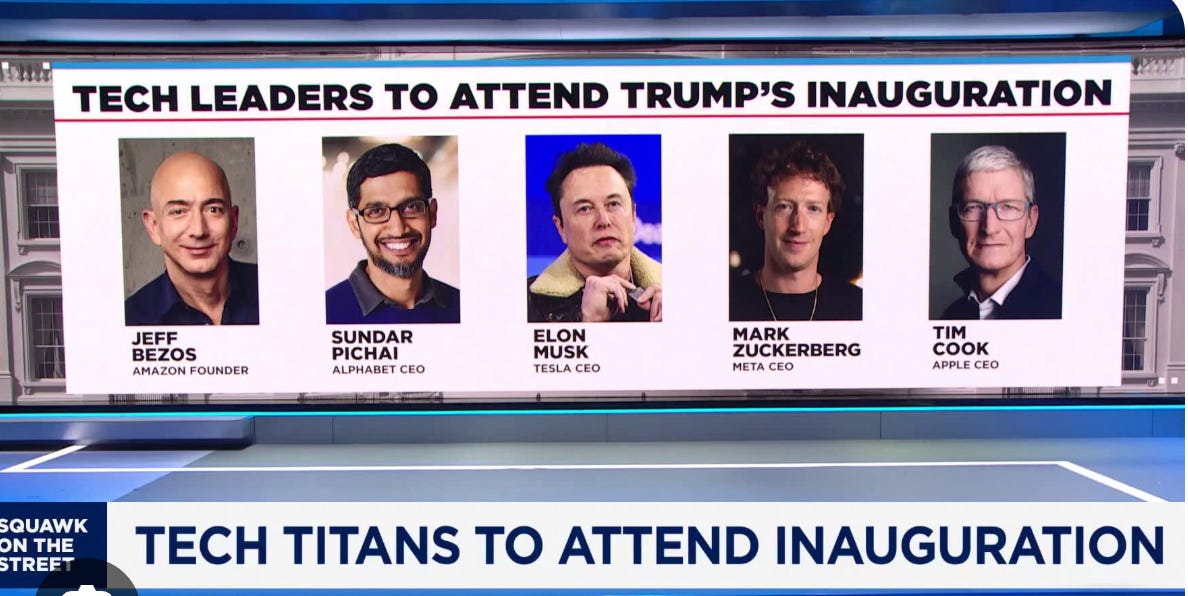
The lack of federal regulation in this area has put all Americans and America in a precarious position. For the first time in U.S. history we are facing an industry worth more than $1T that is almost completely unregulated. Moreover, it is an industry with close ties to the most powerful people in our country. Exhibit 1, the photos below depicting the ‘tech titans’ who stood shoulder to shoulder with the president during his second inauguration

In the absence of national regulation, the job has fallen to states, which to their credit, have stepped up. According to the National Conference on State Legislatures (NCSL) which tracks this data in:
*2025 lawmakers in all 50 states introduced 1,208 AI-related bills, of which 145 bills were enacted into law
*2026 legislative action has accelerated with over 2,190 AI-related bills introduced. As of mid-to-late 2026, at least 84 to 145 additional bills have been passed or signed into law
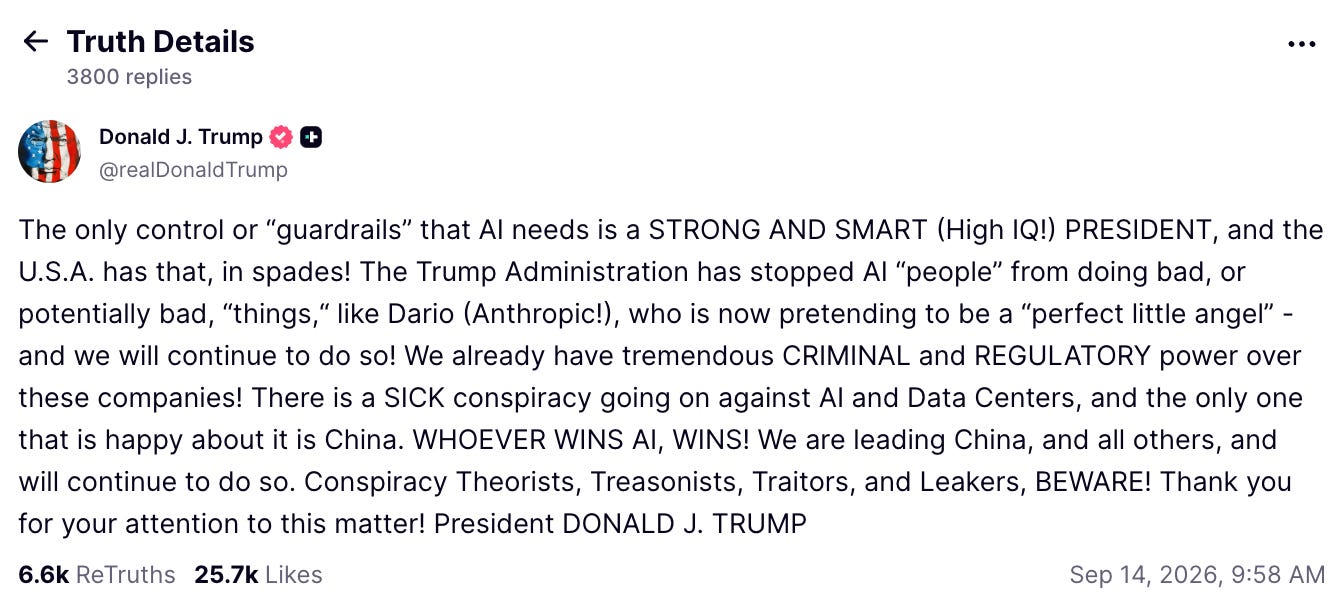
While Trump has made it clear he opposes AI regulation because he fears it will impede our ability to compete with China (see his Truth Social Post below); you know who has AI regulations in place? China! According to Carnegie Endowment for International Peace, “Beijing is leading the way in AI regulation, releasing groundbreaking new strategies to govern algorithms, chatbots, and more.”
It is also worth pausing to ask why tech CEO’s such as Amodei, Altman, Musk, and so many others are calling for AI regulation now? Is it because they have recently and unexpectedly seen something dangerous or is there another explanation for their surprising interest in governmental action? Trump’s close advisor David Sacks is not someone I normally quote in this debate, but on this issue he has a point. As he wrote on X recently, their ‘motivation in calling for regulation is not altruistic.’
Most of all, stop pretending the motivation to slow down is purely altruistic. You face massive product-liability exposure if your products enable a truly damaging cyberattack… After the Hugging Face episode, it is simply good business for OpenAI and Anthropic to trade some raw power for reliability and predictability.
Why then the call for guardrails? It is likely as Sacks notes, if they do not and their products cause damage they will be held liable. It is also likely a concern about competition and an attempt to slow down Open-source. Moreover, if these tech leaders are able to direct the extent, nature, and type of regulation, they can insure the guidelines are not terribly onerous for them, but enough to keep small startups and others who may challenge their hegemony going forward at bay.


Backgrounder:
The tension between Trump & Aomdei
Amodei, who was lampooned on Saturday Night Live just a few hours before he met with Trump last night, has had such a rocky relationship with the administration for some time. It has been so tense that in response to his recent calls for regulation, he has been labeled a “doomer” by some of Trump’s closest allies and chastised for supporting of Kamala Harris in the 2024 presidential election. Just a few days ago, Trump responded to Amodei’s call for AI guardrails by saying he is “pretending to be a perfect little angel”

The source of the tension, however, dates back well before Amodei’s most recent calls for guardrails to a battle between Anthropic and Trump’s Pentagon. Earlier this year, the Pentagon demanded that American AI companies allow it to use their frontier models for “all lawful purposes.” Amodei pushed back, arguing that AI is not reliable when it comes to fully autonomous weapons; he also rejected using it for mass domestic surveillance. When under pressure Anthropic refused to change its position and allow for full use, the Trump administration blacklisted the company and labeled it a “national security supply chain risk”; a designation usually reserved for hostile foreign actors and one which cost Anthropic millions of dollars in military and other contracts. Just a few days ago, the U.S. Court of Appeals for the D.C. Circuit ruled in favor of the Trump administration, arguing the government had acted reasonably. Trump and Amodei’s meeting last night was the first between the two men since the fall out regarding the Pentagon.


